HIGH QUALITY GENUINE OEM, AFTERMARKET SPARES



The global automotive aftermarket has expanded rapidly over the last decade. Digital platforms, improved logistics, and growing vehicle ownership have made it easier than ever to buy car spare parts online. Yet despite this growth, certain parts remain consistently difficult to source.
For automotive marketers, repair professionals, and enthusiasts, these category gaps represent both a challenge and an opportunity. Workshops lose valuable repair time searching for unavailable components. Customers experience longer vehicle downtime. At the same time, businesses that identify and solve these sourcing gaps can build strong authority in the aftermarket ecosystem.
In this article, we explore the most common categories where OEM and aftermarket parts availability still falls short, why these gaps exist, and how modern sourcing platforms are helping solve the problem.
A category gap occurs when a particular group of parts is consistently unavailable or difficult to find across distributors, retailers, or online marketplaces.
Even though many mechanics now prefer to buy car spare parts online, supply chain fragmentation still affects certain product categories.
Common causes include:
These gaps often appear in vehicles that are either very new, very old, or technologically complex.
Before looking at specific categories, it is important to understand the structural issues behind these shortages.
Manufacturers prioritize high volume products such as filters, brake pads, and spark plugs. Rarely replaced components often see limited aftermarket parts production.
Examples include:
Certain components remain heavily controlled by manufacturers, which limits aftermarket alternatives.
These often include:
As a result, repair shops are often forced to rely heavily on OEM supply channels.
Modern vehicles contain significantly more electronics than older models. When new technologies emerge, the aftermarket takes time to develop compatible replacements.
Examples include:
Until the aftermarket catches up, these parts remain difficult to find even when searching for car spare parts online.
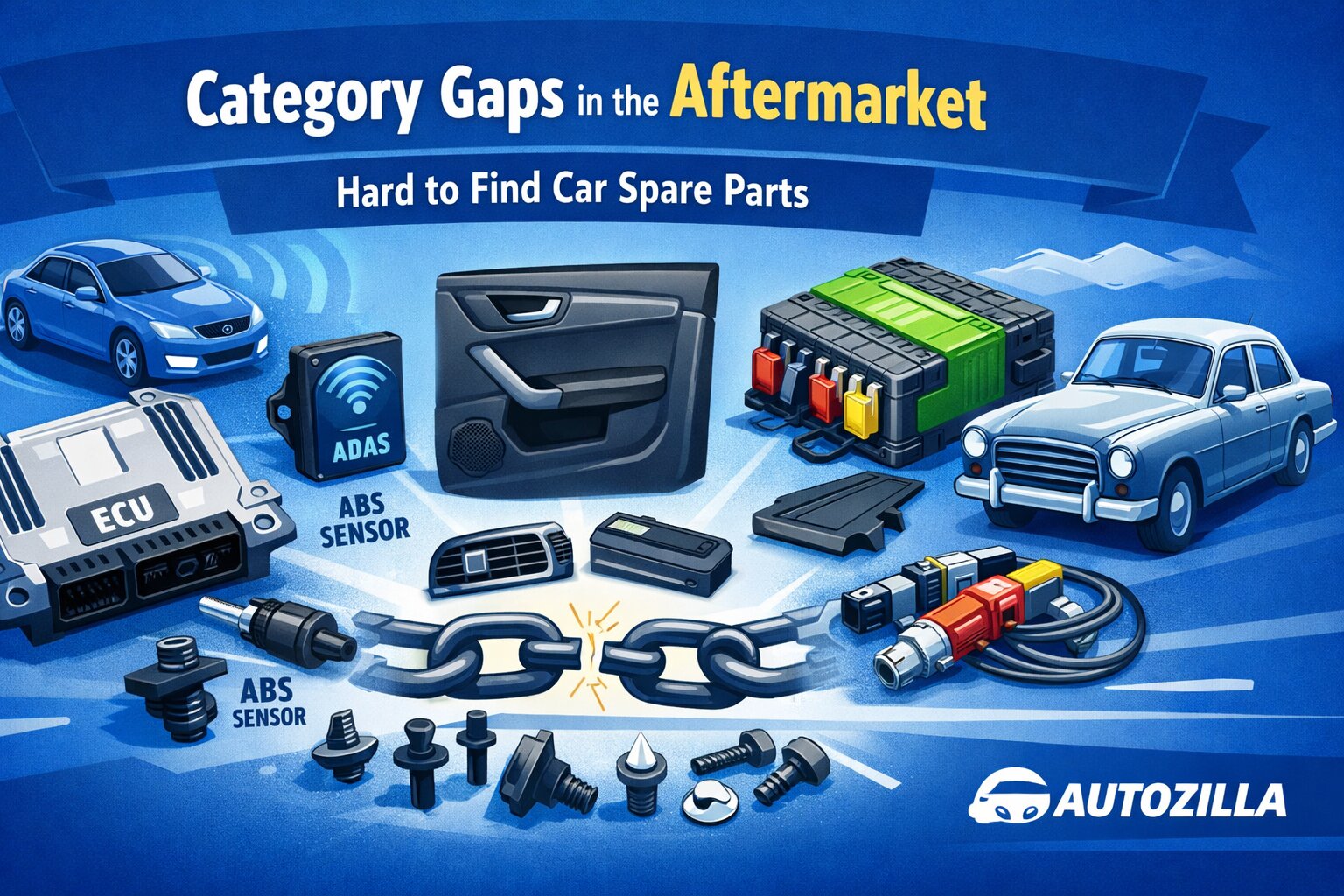
Below are the categories that consistently create sourcing challenges for repair professionals.
Electronic control modules manage many of a vehicle’s critical systems, including engine performance, transmission functions, and safety features.
Challenges include:
Many control modules must be sourced directly as OEM components, which increases both cost and delivery time.
Modern vehicles rely on dozens of sensors to manage performance and safety.
Examples include:
While common models are widely available, variant specific sensors often become sourcing bottlenecks in the aftermarket parts market.
Interior components rarely receive aftermarket attention because replacement demand is inconsistent.
Common hard to find items include:
For these parts, workshops frequently rely on salvage markets or direct OEM procurement instead of buying car spare parts online.
These small components create disproportionate repair delays.
Even though they are inexpensive, missing clips or fasteners can prevent proper installation of larger parts.
Typical examples include:
Many distributors overlook these parts, creating clear gaps in the aftermarket parts ecosystem.
As vehicles age, manufacturers stop producing replacement parts.
Vehicles older than 10 to 15 years often face:
Classic car enthusiasts and repair shops often struggle to locate these parts even when browsing multiple platforms for car spare parts online.
| Category | Why it is hard to source | Typical solution |
|---|---|---|
| Electronic control modules | Software restrictions and OEM control | OEM supply or specialized refurbishers |
| Vehicle sensors | Model specific compatibility | High quality aftermarket equivalents |
| Interior trim parts | Low demand for reproduction | Salvage parts or OEM sourcing |
| Clips and fasteners | Low priority for distributors | Specialized fastener suppliers |
| Older vehicle components | Discontinued manufacturing | Remanufactured or niche aftermarket brands |
The rise of digital sourcing platforms is helping reduce traditional distribution barriers.
Instead of relying only on local suppliers, repair professionals can now access broader inventories when buying car spare parts online.
Modern aftermarket platforms provide:
These capabilities significantly reduce sourcing time for difficult aftermarket parts.
VIN based searches help locate compatible OEM and aftermarket parts faster and reduce the chances of ordering the wrong component.
Some parts may be available under smaller aftermarket brands that are not widely distributed across mainstream channels.
Independent distributors often carry niche inventories that are unavailable on major marketplaces.
Dedicated automotive parts platforms usually offer deeper catalogs compared with general ecommerce sites. This is why many professionals prefer to purchase car spare parts online through platforms built specifically for the automotive aftermarket.
For businesses operating in the automotive ecosystem, category gaps present a strategic opportunity.
Companies that focus on underserved segments can gain:
Examples include brands specializing in:
These niches often outperform more saturated product categories.
Despite rapid growth in the automotive aftermarket, certain components will always be harder to source. Electronic modules, vehicle sensors, interior trim pieces, and discontinued parts continue to create friction for repair professionals.
However, modern digital marketplaces are changing how the industry solves these challenges. By expanding inventory visibility and connecting multiple suppliers, professionals can now locate many difficult components when buying car spare parts online.
If you regularly deal with sourcing delays or inventory gaps, the most effective solution is to use a platform built specifically for the automotive aftermarket.
Autozilla simplifies the process by helping professionals quickly locate OEM and aftermarket parts across multiple suppliers in one place. Instead of spending hours searching across distributors, workshops and enthusiasts can find the right parts faster and keep vehicles on the road.
Need genuine car parts? Browse our wide collection at Autozilla and discover a smarter way to buy car spare parts online.
Visit Autozilla and find the right parts for your car in just a few clicks.